Labor and Employment
Untrained Managers Create Legal Risk: Federal Training Requirements Every Employer Must Follow
By Peter Spanos

Many employment lawsuits I have handled on behalf of employers had something in common: a manager made a deficient decision or failed to act appropriately because no one had trained them properly. Sometimes the decision was a termination made without documentation. Sometimes it was a failure to recognize a harassment complaint and how to respond. Sometimes it was a well-meaning accommodation conversation that crossed a legal line.
The lesson is not complicated. Under federal law, your managers are your company’s legal agents. When they act, or fail to act, the law generally treats it as the company acting. Liability flows upward. Training is the mechanism by which you limit that exposure.
Title VII of the Civil Rights Act of 1964, along with the Age Discrimination in Employment Act (ADEA) and the Americans with Disabilities Act (ADA), prohibits workplace harassment based on protected characteristics. The EEOC’s enforcement guidance makes clear that employers are expected to take reasonable steps to prevent and promptly correct harassment.
But the most compelling reason to train managers is a practical defense, not a moral one.
Under Faragher v. City of Boca Raton (1998) and Burlington Industries v. Ellerth (1998), the Supreme Court held that an employer may avoid vicarious liability for a supervisor’s harassment — if no tangible employment action resulted — by demonstrating two things: (1) that the employer exercised reasonable care to prevent and correct harassing behavior; and (2) that the employee unreasonably failed to use the employer’s preventive or corrective opportunities.
You cannot establish the first prong without documented manager training. Courts consistently look for:
- A written anti-harassment policy that is distributed to all employees
- A complaint procedure that bypasses the immediate supervisor when that supervisor is the alleged harasser
- Regular, documented training for managers on recognizing, reporting, and responding to harassment complaints
- Training that addresses bystander intervention obligations and retaliation prohibitions
Practical Tip
Managers must understand that their obligation is not merely to avoid harassing behavior themselves, it is to act when they observe or learn of harassment by others. A manager who witnesses harassment and does nothing creates employer liability, regardless of whether there is a reporting policy.
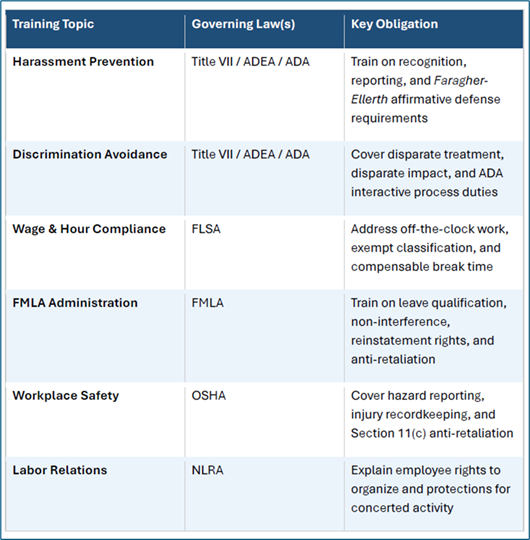
Quick Reference: Federal Manager Training Obligations
The table below summarizes the primary federal laws that impose manager training requirements and the key compliance obligations in each area.
The Bottom Line for Employers
Federal employment law does not require perfection. What it requires is a good-faith, documented effort to comply. In practice, that means written policies, a functional reporting structure, and — above all — managers who are trained, periodically re-trained, and held accountable for what they know.
When a lawsuit or agency charge arises, one of the first things plaintiff’s counsel and investigators request is documentation of manager training. The question they are asking is simple: did this company do what a reasonable employer would do to prevent this from happening? Training records, or the absence of them, answer that question before the first deposition is taken.
If your organization does not have a structured manager training program addressing each of the areas discussed in this article, now is the time to build one. The investment is modest. The cost of the alternative is not.