OK Voices
Michael Freestone on Family, Heritage, and the Spirit of St. Patrick’s Day
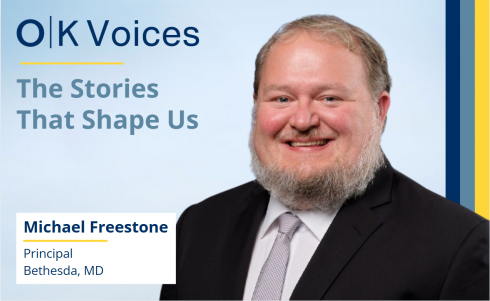
In this edition of "O|K Voices – The Stories That Shape Us," we are highlighting attorney Michael Freestone in honor of St. Patrick’s Day. Michael shares his Irish heritage, reflecting on the traditions his family has carried on and what the holiday means to him. From childhood celebrations to the cultural significance of St. Patrick’s Day, Michael’s story offers a glimpse into the history and pride that comes with embracing one’s roots.
How do you typically celebrate St. Patrick’s Day?
Typically, I celebrate St. Patrick’s Day with my family, some good food, and probably a Guinness. My wife’s family are O’Donnell’s and take it pretty seriously as well. Since St. Patrick’s Day is almost always around the Six Nations Rugby Tournament, we tend to have a gather of friends and family that weekend. Food has always been an important of celebrations growing up. The Irish side of my family lived in Birmingham in the UK which was one of the larger areas of Irish immigrants in the UK.
In terms of food, I always make soda bread and more recently corned beef. My favorite soda bread recipe is from the Ballymaloe house (a famous Irish culinary institution). White Soda Bread | Ballymaloe Recipes | Ballymaloe House Hotel Cork
For something different and probably closer to my family’s roots I do recommend a Northern Irish traditional farl – a soda bread cooked in a skillet. Soda farls recipe | Good Food
I would say that Irish stew is probably more famous in the UK and less so here. Also, my wife is not a big fan so it’s out of rotation for the time being.
Do you think St. Patrick’s Day is more widely celebrated in Ireland or here in the U.S.? Why?
I think St. Patrick’s Day is more widely celebrated here in the United States. That’s not to say there are no celebrations in Ireland – they really do a good job. But they aren’t dying the river Liffey green or anything on the scale of the U.S. Some of my favorite “Paddy’s day” celebrations in Ireland have been at local pubs with great traditional Irish music. I think the Irish American population has found St. Patrick’s Day to be very important cultural event and has moved beyond the religious aspects to instead celebrate a spiritual homeland.
What are some differences between celebrations in Ireland (or the UK) vs. celebrations in the U.S.?
I think the scale of celebrations in the US is on a whole other level. The UK has a very large population with ties to Ireland (my family included) and St. Patrick’s Day is celebrated extensively but the US and Ireland do it the best I would say. The expansive nature of the Irish diaspora (over 70 million people globally) means that St. Patrick’s Day is increasingly a worldwide celebration. Foodwise - one thing that I found different was the focus on corned beef as a focus for the holiday. Corned beef is so named from the British navy tradition of preserving beef and in the UK, it is referred to as salt beef most often. It’s a uniquely Irish American tradition dating back to immigrants in New York I believe. But you can’t have a conversation about Ireland without the diaspora and immigration and so the corned beef perfectly sums that up.
Do you see the traditions/celebrations growing or shrinking in recent years? Why?
I think the best example of why St. Patrick’s Day is going to continue to celebrate is summed up by the recent run on Guinness with pubs running out of the Irish staple. Seriously though, the timing of St. Patrick’s Day in early spring make it one of the best-timed celebrations.
Some pubs start to run out of Guinness as supply limit bites
What aspects of Irish culture do you think are the most significant today?
It’s hard to adequately describe the most significant parts of Irish culture suffice; to say that for a small country, Ireland has an oversized presence in many aspects of life. Literature, arts, music, and now life sciences are areas that the influence of Ireland is immense. Modern-day Ireland is also a global leader in standing up for peace and international development and supporting the European experiment, while other countries have let themselves down in that regard. By way of background, I studied at Trinity College Dublin for my undergraduate degree, and I majored in Theatre and Film, both areas in which Ireland has a had commanding presence.
What is your favorite Irish tradition, and why?
Ireland has some fantastic traditions with their unique music, sports, and cuisine. But for me the Irish so called “gift of the gab” or as I experienced I the “craic” which roughly translates to a good time is my favorite. The ability to find humor in conversation and connect with people that you meet is a trait that is hard to find – except in Ireland. Also, craic is a very useful word with many applications, such as: “That was good craic” (that was fun) “what’s the craic?” (what’s going on) etc.
What are some lesser-known facts about Irish history that you think more people should know?
The story of the famous well of St. Patrick is a Trinity legend. The holy well was used by St. Patrick to baptize his first converts in Ireland and became an important focus point in the city. Records of its exact location are lost, but it is thought to have been located around the south end of what is now Trinity College. The well was the focus of celebrations around the holiday of St. Patrick. Disaster struck in 1729 when the well ran dry! Notable Trinity College graduate Jonathan Swift (author of Gulliver’s Travels) at the time wrote a scathing poem blaming the fountain running dry on the carousing of Trinity College students and also a scathing commentary on British governance of Ireland. Close to the Provost’s house and stables on campus, there is a sealed vault that purportedly holds the well.
Michael and his family in the Giant's Causeway, Ireland (1993) |
Michael’s grandfather with his father and brother in the wilds of Ireland |
Michael’s family generational home in Kildallen, Co. Cavan |


Our Diversity, Equity, and Inclusion (DEI) Committee is proud to present “O|K Voices – The Stories That Shape Us,” a series dedicated to celebrating the personal experiences of our employees. Each edition will highlight employee stories or cultural events, offering a platform for colleagues to share their traditions, histories, and the moments that have shaped them. Through these shared voices, we foster deeper connections, understanding, and appreciation of the diverse perspectives that make up the Offit Kurman community.