Construction
Practical Steps to Take When a Schedule or Time Impact Dispute Arises
By Jeffrey Bright
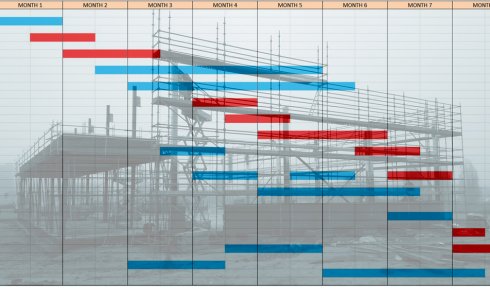
Construction projects are frequently delayed and take longer than originally anticipated. When a project is delayed, claims often arise for liquidated damages, delays, disruptions, and cost overages. Here are a few practical considerations for where to start when organizing your time impact dispute.
Start with the Schedule
Often, litigants immediately send threatening letters regarding costs, claims, losses, blame, etc.; however, it is best to start with a clear understanding of the delay as shown on the schedule. To do so, your project manager, attorney, and any expert consultant should start by reviewing key, fundamental information.
- Was there a written contract with a completion date or milestone deadlines?
- Were those deadlines extended by already approved change orders or extensions of time?
- Did the contract have a baseline schedule?
- Was the project schedule updated throughout the project? Were there updated as-built schedules (showing the work durations, as actually performed), as well as updated projected schedules for the work yet to be completed?
- Are the schedules available in the native software format?
- Are there accompanying schedule narratives?
An initial analysis should start with a clear understanding of the schedule itself.
Establish why the Project was Delayed
Alongside the schedule for as-built and projected work, it is necessary to understand what events, incidents, acts, or omissions are the supposed causes of the delay. Frequently, claimants will identify a list of issues or problems on the project and assert that these caused the delays.
That’s a good start. But even better: You should be able to identify a list of time-impact events (incidents, acts, or omissions) that are the cause of the delay. And for each event, identify how and to what duration/extent it impacted the critical path of the work.
Additionally, for each event there should be proof. Text messages and emails are typically very burdensome, inefficient, and sometimes inadequate to show the event. For example, if your work is delayed because a separate trade’s predecessor work is incomplete (or incorrect), it is best to have more documentation than an email. There should be documentation showing the origin, investigation, remedial action, and conclusion of the incident. There should be photographs, daily logs, meeting minutes, RFIs, redesign, and/or change order proposals.
For each event, you should be able to present a narrative and supporting proof that concisely explains what the event was and how it impacted the critical path for the work.
Establish that Notice of the Event was Issued, and Progress it to a Formal Claim if Necessary
Typically, the contract documents differentiate notice of the event as different than a formal claim. Notice of the event is for the purpose of addressing the issue. This serves both a legal purpose, as well as a construction purpose— to keep the project moving forward. Most contract documents will require notice to be given with reasonable promptness. This should be a documented written notice, which might accompany an RFI or other documentation, such as a change order proposal.
Recognize that notice of the issue should clarify what the issue is, and if you believe it will cause additional costs or time. If you only request additional costs or additional time, but not both, you may be waiving your right to full relief.
Generally, after the notice of the event has been issued, if the matter has not been resolved through some other means, it is best practice to issue a formal request for equitable adjustment, change order, or invoice, seeking the remedy of additional time, money, or both. It is important to track costs and delays with precision so that your requested relief is specific, reasonable, and supported by the evidence. If you fail to submit the REA/CO, then, it may be more difficult to obtain relief. Most contracts have deadlines for submitting such requests, and, further, most project players are unimpressed with end-of-project REA/CO, because it is preferred to address these issues while the item is pending and immediate.
Most contract documents will then have a “claims process” for transitioning the proposed or rejected REA/CO to a formal claim. When consulting with your attorney or expert, the quantifications (and supporting proof) for the requested time or compensation should be organized to facilitate the most efficient approach to claims handling.
To summarize:
- Start with clear, organized documentation of the project schedule and deadlines
- Prepare organized explanations and proof of the time impact events
- Accurately quantify the impact with supporting proof so that the requested time and compensation are based on credible data/evidence
- Promptly notice the time impact issue, the request for relief and, if the request is rejected, the claim
When handling time impact issues on a project, whether that be delays, disruptions, liquidated damages, or related cost overages, it is best to consult with your attorney and experts. By properly organizing, supporting, and noticing requests/claims, the preference is to reach amicable resolutions without the need for lengthy claims processes or litigation.
This article also appears in the January 2026 edition of the Spokesman, a publication of ABC Keystone.