Press Releases

Offit Kurman Welcomes Corporate Attorney Shushan Barsegyan to the Los Angeles Office
December 1, 2025
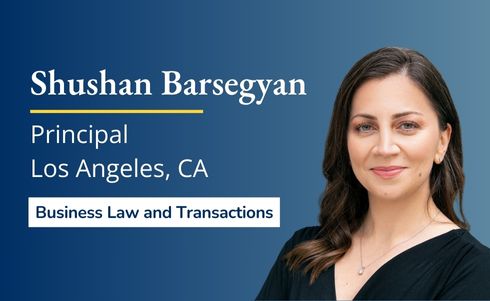
Offit Kurman Welcomes Corporate Attorney Shushan Barsegyan to the Los Angeles Office

Offit Kurman is pleased to announce that Shushan Barsegyan has joined the firm as a principal in the business law and transactions practice group. Based in the Los Angeles office, Shushan advises business owners, entrepreneurs, and growth-oriented companies throughout the full lifecycle of their enterprises, from formation and early development to complex transactions and multi-entity operations.

For more than a decade, Shushan has served as a strategic legal partner to companies across technology, hospitality, fashion, experiential entertainment, professional services, and consumer-focused industries. She regularly counsels on mergers and acquisitions, ownership structuring, commercial contracts, joint ventures, reorganizations, and governance matters, and has represented buyers and sellers in multimillion-dollar M&A transactions. Companies also rely on her as outside general counsel for ongoing operational, risk management, and organizational planning needs.

Before joining Offit Kurman, Shushan founded and led a boutique corporate law practice, bringing firsthand business insight that informs her practical, results-driven approach.

Firm Highlights

  • Podcasts
    Artful Donations: Exploring Museum Exchange
    In this episode of The Legal Canvas, host Caryn Keppler welcomes Robert Wainstein and Michael Darling, co-founders of Museum Exchange, the first digital platform dedicated to facilitating art donations to museums and nonprofit institutions across North America. Together, they explore how technology is transforming the way collectors, artists, estates, and cultural organizations connect through charitable giving. Robert and Michael explain the inspiration behind Museum Exchange, the challenges they set out to solve, and how the platform has grown into a network of more than 400 museums. They walk listeners through the donation process—from evaluating artwork and matching donors with institutions to handling logistics, documentation, and tax considerations. Along the way, they discuss the realities of museum collecting, why many donations are declined, and how thoughtful placements can help preserve artists' legacies while expanding access to important works of art. The conversation also explores Museum Exchange's work with living artists, artist estates, hospitals, universities, and smaller regional museums, as well as the launch of the Charis Foundation for the Arts, a nonprofit designed to steward significant collections before placing them with institutions that can best benefit from them. Robert and Michael conclude by sharing their vision for the future of charitable art transactions and how Museum Exchange is helping reshape philanthropy in the arts for generations to come.