Blog Posts
Business
What M&A Buyers Lose by Keeping Their Closing Checklists to Themselves
I recently represented a group of business owners in the sale of their company. As with any merger or acquisition, the transaction demanded tremendous patience, effort, and commitment from all people involved. For my clients, however, the deal was far more onerous than it needed to be — because the buyer’s attorney chose not to work from a closing checklist. A closing checklist can be thought of as a shared roadmap for an M&A transaction. It lays out all the steps that must be taken to bring the deal to fruition, specifying the roles and responsibilities of the buyer, the seller, and any other participants. Checklists cover everything from sophisticated legal and financial considerations (e.g. intellectual property searches, lien releases, third-party consents) to minute particulars such as signatures and wiring instructions. Whatever its level of detail, any checklist is better than none. Deals without closing checklists sometimes waffle as parties experience distrust, restlessness, and confusion over priorities. While this transaction fortunately did go through, my clients faced significant friction and frustration. At times, a collapse appeared likely. Instead of providing a closing checklist, the buyer essentially assigned us several dozen to-dos, which was just a rundown of tasks we needed to complete in order to satisfy their pre-closing requirements. It was a one-sided, opaque way of doing business. It left us feeling as though we were operating in a vacuum and never working fast enough. This kind of approach not only strains the lines of communication between a buyer and seller, but also tends to dissolve any kind of meaningful negotiations. When you’re rushing through line items without the larger context of the deal in mind, you give up your leverage. A closing checklist is essential because it situates parties within the same universe and keeps their attention oriented on a shared goal. It’s a common point of reference for discussions and perspective — a constant reminder that all that labor and stress is in service of a mutually beneficial transaction. If you don’t have a closing checklist, you become blind to the other side’s objectives as well as your own. What is particularly baffling about the decision to keep the seller in the dark is that it creates more work for the buyer. Closing checklists are generated in almost every transaction. They flow naturally from the buyer’s documentation and due diligence. There’s no additional effort or risk to making them generally available to the other party. By refusing to share their checklist, the buyer chooses instead to dole out the information in a piecemeal manner, potentially causing errors and slowing down the deal. It’s the difference between telling a seller what you aim to accomplish and telling them what to do. It’s turning what should be a partnership into a managerial relationship. And ultimately, it’s unproductive. Few owners can put up with being bossed around—especially when they’re in the middle of exiting their business. Originally posted 09/26/2019 - no content changes.
October 3, 2024
Business
The Entrepreneur’s Lab Video Series: Definitive Sales Agreement
Definitive sales agreement – the sales agreement is the key document for the seller in a transaction. It encompasses the hard work of the parties from LOI through diligence. Definitive agreements typically are drafted by the buyer’s counsel and will be a large document with many moving parts. A few of the key parts are as follows: The business terms: A seller needs to make certain the key terms in the LOI are accurately and fully reflected in the agreement. Typically, the first portion of a definitive agreement speaks to the price, the payment terms, and the related items. Representations, warranties and covenants: The largest part of the agreement will be the various reps and warranties required of the seller. These reps are statements of truth about the business and will need to be carefully reviewed with legal counsel to make certain no modifications are necessary. Conditions to closing: A seller needs to be keen on any conditions in the agreement that need to be satisfied prior to closing. Such conditions could include buyer’s financing or the obtainment of certain customer consents. Indemnifications: Remember the buyer will want to pass the risk of any issues arising prior to closing back to the seller. A seller needs to fully understand the risk of indemnification and make efforts to cap and/or limit future exposure. Disclosure schedules: These schedules supplement the agreement, especially the reps and warranties. In many respects, disclosure schedules culminate and complement the diligence process. As a seller, disclosure and completeness is your friend. Make certain that your sell-side schedules are accurate. Originally posted 2/16/18. No content changes.
September 26, 2024
Business
Not Sure if Your Company Is Ready to Sell? Consider the PAEI Model
For most business owners, the chance to sell your enterprise is a once-in-a-lifetime opportunity. But if you take that offer too early or at the wrong stage of business development, the sale could result in a number of undesired outcomes: a low valuation, difficulty finding a buyer, management disputes, contract issues, and other legal problems. Selling a business is like preparing a meal. It’s crucial for a business owner to be able to recognize if their business is either under or overcooked before taking it to market. Unfortunately, it’s not as simple as using a meat thermometer. Instead, owners rely on systems such as the PAEI Model, which Dr. Ichak Adizes developed in the 1970s to track business growth and stability. To this day, business owners use the model to understand their organizations’ lifecycles through the lens of management dynamics. How the PAEI Model Works “PAEI” stands for four different yet common management personae that affect a business’s short-term and long-term performance. Producers are managers who are task-oriented and focused on tangible results. They demonstrate big-picture thinking with little regard to interpersonal or individual concerns. Administrators are managers driven by procedure and planning, with a strong focus on routine and structure in order to maintain success. Entrepreneurs are managers driven by dreams and future achievement. They’re concerned less with day-to-day operations and more with a broad, long-lasting vision of the business. Integrators are managers who work well with others. These individuals are adept at both considering and balancing the concerns of other managers and employees. Each of these roles is important to business development, but each has its own time. The PAEI model lays out an arc of business growth, starting with “Courtship” (when an owner “flirts” with the business idea), which leads to “Infancy,” “Go-Go,” “Adolescence,” “Prime,” and ultimately stability. Which Stage Is the Ideal Moment to Sell? Every stage can spin off into a negative conclusion. For instance, Infancy can result in “Infant Mortality” when there’s nothing left but a Producer. Adolescence, meanwhile, can result in “Divorce” (the owner and the company split), which may lead to “Premature Aging” (the company peaks early without an entrepreneurial vision) and an “Unfulfilled Entrepreneur.” To avoid the potential pitfalls during every stage of a business’ lifecycle, each one of the four management styles must be present. But not everyone comes to the foreground in every stage. Instead, a single management style or combination of styles takes dominance at certain points along the way. For example, in Courtship, the very beginning stages of a new business, the Entrepreneurial management style is required for crafting the initial big ideas and long-term goals that will sway investors and fund the enterprise into Infancy. Once the money rolls in and the business reaches Infancy, it’s important for a Producer to recognize how to responsibly use the startup funds to survive on a daily basis. After some inevitable growing pains, a business reaches Adolescence with the help of an Administrator, whose management style shifts the focus away from sales and revenue generation—and toward cost-cutting, boosting profits, and keeping the company lean. At this stage, an organizational structure is key in order to reach the Prime period of a lifecycle. When the business is in its Prime—when profits are up, operations are running smoothly, and customer satisfaction is at an all-time high—that’s when it’s time to sell. Yes, believe it or not, the best time to sell your business is usually right before it reaches the Stable stage. While further growth can seem all but guaranteed at the Prime stage, according to the PAEI model, most companies begin to falter and precipitously lose value once they’ve become Stable. This is the period in which the Entrepreneurial management style begins to fade, and the Administrative and Integrator styles achieve dominance. In other words, the initial visionary is replaced by people who excel at bureaucracy and longevity. In the realm of mergers and acquisitions, the Integrator is frequently the buyer. As a seller, it’s up to you to ensure the business has reached its Prime and that all the elements are in place for continued success—and to get out right before the business peaks and starts to lose value. While the PAEI Model is not a guaranteed method of success, I believe it can provide rare insight into the business lifecycle. It presents a valuable framework for the roles and traits it takes to reach success and ultimately earn the highest possible sale price for your company.
September 19, 2024
Business
Letters of Intent (LOI) – Buyer’s Exclusivity
I’ve reviewed many LOIs over the years – some we’ve prepared and others the client prepared. I’ve found that too many people view LOIs as form documents containing commercial terms. Yes, LOIs are vital documents establishing the commercial terms of a transaction. However, LOIs should not be considered “throwaway” forms in the M&A process. I think the lax attitudes relate to the non-binding nature of most terms in the LOI. Yet, there should be specific binding terms in every LOI. For a buyer, one important binding term is the exclusivity provision. Most recently, I needed to enforce this provision due to a seller’s breach. My client invested much of their time and money evaluating a transaction and documenting the same (legal, accounting, and banker time). The exclusivity provision protects a buyer from a seller “two-timing” them by not committing fully to the contemplated transaction and not negotiating in good faith. In my instance, the seller committed to another transaction during my client’s exclusivity period, leaving my client with much frustration and wasted costs. Buyers rightly demand a fair time frame to evaluate and work with a seller to consummate a transaction. Buyers invest substantial front-end costs in this regard. Fairtrade is for the seller to commit to an exclusivity period (30, 60, 90 days) to allow the parties to finalize a transaction in good faith. My client had an exclusivity period with “teeth” that allowed him to recoup these costs – and the seller did reimburse. But buyers beware. Without an adequate exclusivity provision, among other protective provisions, much time and money can be lost when a seller changes course.
September 12, 2024
Mergers and Acquisitions
In M&A, a Seller’s Greatest Asset Is Their Engagement in the Deal
Every business owner understands the importance of employee engagement. Keep your team motivated and energized, and you’ll maximize profit, productivity, retention, and customer satisfaction. When the time comes to sell your business, you'll need to cultivate that same level of engagement within yourself. You’re the one in the driver’s seat; no one else can steer the process for you. If you aren’t totally invested and enthusiastic about the deal, you risk missing out on the best possible sale price or letting the transaction fall apart. Keep in mind that during a merger, acquisition, or other business transaction, a seller takes on two jobs: selling a company and running a company. Neither job is easy. Both require full engagement, attention, and leadership acumen. I like to say that during an M&A transaction, you operate your business from 9 a.m. to 5 p.m., and you sell your business from 5 p.m. to midnight! During the transaction, the business owner needs to make themselves readily available to evaluate buyers, negotiate terms, produce documents, answer questions, and actively engage in other elements of the transaction. As a seller, the owner must also sell their business — convincing the other party of their vision, of the company’s valuation, and why the organization is an excellent buy. At the same time, the owner is still involved in the day-to-day operations of the business. We’re talking about governing organization-wide initiatives, developing strategies, making decisions, communicating to internal and external stakeholders, and everything else leaders do on a daily basis. In addition to these full-time responsibilities, the owner is typically hard at work on the transition — readying employees for the changes ahead, locking down key contracts, keeping vendors and business partners updated, and so on. If that sounds like a lot to handle, it’s because it is. It’s like undergoing an extended federal investigation while pushing your business as aggressively as a used car salesman would. Sellers need to prepare financially, emotionally, and psychologically for the difficult road ahead. They need to figure out their goals and objectives early and stick to them resolutely. Fortunately, sellers don’t need to manage it all alone. Business attorneys, investment bankers, valuation professionals, and other M&A advisors can provide much-needed support and sanity checks. That said, we can’t get the deal done without your direction and continual involvement. Again, the operative term is engagement. I’ve worked with clients who lacked engagement and damaged their deals as a result. You need to consider decisions, read every document, and follow through all the way. If your attorney asks you for your business contracts, they don’t want to hear “here’s most of them.” You need to provide all of them, not 80%, not 90%. “Good enough” doesn’t cut it. The buyer who’s going to pay you millions of dollars isn’t going to stand for “good enough” or “most of what I could find;” they need everything, or they need to know what you can’t find and why. On the flip side, there’s such a thing as getting too engaged in the transaction. Micromanaging is a form of sabotage. Trust the members of your team to do their jobs. Insisting that you need something done by Friday has no impact on your attorney’s ability to do it. Deadlines should be based in reality. Moreover, the attorney may have a good reason for taking their time. Sometimes, it’s simply smarter to wait and see how things play out so you can make better-informed decisions. Remember that a business transaction is a dance, a push-and-pull between buyer and seller. If the only reason you’re rushing through it is to check a box, you could be losing perspective on the deal and giving up your leverage. Any effective arrangement between a business owner and an M&A advisor is a partnership. While healthy discussion is good, each partner fundamentally needs to do their part and stay in their lane. A lawyer shouldn’t be asked to provide guidance on net-working capital—that’s an investment banker’s job. By the same token, the banker’s input on legal matters shouldn’t supersede the attorney’s recommendations. And as the business owner, you’re ultimately the one calling the shots. It’s your business, your transaction, your future. Grab hold of the wheel and put your foot on the pedal. Originally posted 10/25/19, no content changes.
September 5, 2024
Business
I’m a Potential M&A Buyer; Should I Focus on Buying Stocks (Equities) or Buying Assets?
When an M&A buyer is looking into a target company, they’re faced with the decision whether to buy stocks (the equities) or acquire assets. But what’s the difference? A stock purchase involves the purchase of the selling company’s stock only. Simply put: the buyer acquires all of the outstanding stock of the target company directly from the target company’s stockholders, including the assets, rights, and liabilities. The buyer then steps in the shoes of the selling stockholders (switches places). Stock purchases are generally straightforward transactions. Both parties sign a Stock Purchase Agreement (a sales agreement used to transfer and assign ownership in a corporation) and any other related documents that outline the terms of the deal, and the sellers then transfer their stock to the buyer. It seems simple enough, right? For the most part. There are risks, such as unknown or undisclosed liabilities of the target company. Again, when you purchase the stock, you become the stockholder; thus, nothing at the company level changes (save perhaps change of control issues). Operations remain intact as do all risks and liabilities. In addition, stock sales generally have favorable tax treatment for sellers. But what if you don’t want to buy everything and/or you want to limit your risk exposure? You might then be more interested in an asset purchase. An asset purchase is an agreement between a buyer and seller to acquire a company’s assets. This means: the buyer only acquires the assets, rights, and liabilities it identifies and agrees to acquire and assume. Assets can be both tangible, such as offices and equipment, and intangible, such an intellectual property and corporate name. Asset purchases are a good option if you’re looking for more flexibility and don’t want to pay for unwanted assets. Further to that point, it means less risk of assuming unknown or undisclosed liabilities. Asset purchase transactions are generally more favorable to a buyer and at times less favorable to a seller. Some buyers may be deterred by asset acquisitions because they’re more complex than stock purchases. The buyer has to spend time identifying the assets it wishes to acquire/assume. By doing so, the buyer may potentially overlook an important asset required to run the business it’s acquiring. Asset purchases have more formalities and documents since they require a separate transfer for each of the identified assets and liabilities of the target company. They may also require more third-party consent since the contracts assumed by the buyer are likely to contain anti-assignment clauses (which prevents either party the ability to assign tasks to a third party without the agreement of the non-assigning party). Whether you’re considering a stock purchase or an asset purchase, it’s always best to discuss it with an M&A attorney first. Selecting the form of the transaction is a key consideration when targeting the purchase of a business. There are many variables to consider as to why a transaction is set as a stock purchase versus an asset purchase. Originally posted on 9/9/2020, no content changes.
August 29, 2024
Business
From the Field to the M&A Negotiating Table, Every Successful Team Shares The Same Dynamics
They say there’s no “I” in “team.” Tellingly, for the parties in merger or acquisition, it’s also impossible to spell “team” without an “M” or an “A.” But I’d like to introduce you to a different set of letters. Even though you can’t find them in the word itself, every team should contain three “Cs”: cohesion, collaboration, and culture. Over the course of my career as a business attorney and advisor, I’ve seen many transactions succeed—and witnessed many more fall apart. Every deal that’s gone through could not have happened if not for a cohesive, collaborative, culturally connected team. Speaking as a sports fan, I could say the same about a squad like the Ravens, the Bulls, or the Bruins. Whether we’re talking about a sports team or a corporate team, the Three Cs are paramount for optimal results: Cohesion is the team’s capacity to stick together, through the good times and the difficult moments. It’s the fundamental element every group needs to take on risk and uncertainty, survive failure, and doggedly pursue its goal. Without cohesion, there is no team. Collaboration is how the team works together as a unit, maximizing each team member’s strengths to become something more than the sum of their individual abilities. Collaboration ensures the team is operating at its full capacity. It’s how team members keep each other accountable, engaged, and in the game—be it a real game or a metaphorical one. Culture is everything the team cares about and stands for—the values, principles, beliefs, assumptions, and personalities that make the team unique. A team’s culture determines how and why the team does what it does. Culture eclipses everything else; it’s how Joe Namath led the Jets to triumph over the Colts, the so-called “greatest football team in history,” in Super Bowl III. The Three Cs are essential ingredients of all successful teams, but they aren’t the only qualities that matter. Many teams with extraordinary M&A records have been together for a long time—sometimes years. Time not only imparts experience, but builds team confidence and predictability. Diversity matters as well. An M&A advisory team should be comprised of individuals from different disciplines, such as leadership, accounting, law, and investments. Many successful sellers and buyers build teams from their networks: they tap their closest colleagues and associates for support; hire attorneys, bankers, and other M&A consultants; and then bring in trusted advisors from their organizations’ boards of directors, executive suits, and finance departments. Finally, even the smartest, most experienced and diverse teams need to watch out for dysfunction. Everyone on the team should share a single goal: deal consummation. Internal dysfunction can impact everything from timing to cost structures. With that in mind, effective M&A teams work on resolving conflicts early, build open lines of communication, and save their competitive energy for the playing field—or negotiating table. Originally posted on 1/25/2019, no content changes.
August 22, 2024
Mergers and Acquisitions
Four Reasons Sellers Have a Natural Disadvantage in M&A Transactions
“The roulette table pays nobody except him that keeps it. Nevertheless, a passion for gaming is common, though a passion for keeping roulette tables is unknown.” So wrote George Bernard Shaw, the Irish playwright and London School of Economics co-founder, over a century ago. Were Shaw alive today, he would make a shrewd mergers and acquisitions (M&A) advisor. In an M&A transaction, the keeper of the roulette table is the buyer: the organization, group, or individual interested in purchasing a company. Sellers are at an inherent disadvantage because they’re engaging on the other party’s terms. They’re sitting across from someone who sets the rules, who holds the chips, who has bet—and won—numerous times before. To attempt to outsmart or overpower the buyer is to play against the house: you’re almost certain to lose—and wind up in a worse position than where you started. If this sounds dramatic, that’s because it is. While no deal is a pure gamble, there’s always some level of risk and uncertainty involved. And if a seller doesn’t adequately prepare and check their expectations, they could be putting millions of dollars and countless hours on the line. Consider some of the basic advantages buyers have over sellers during an M&A transaction: 1. The Buyer Tends to Have More Resources A business owner may have a hot commodity on the market, but a buyer has money. Guess who has better leverage? Moreover, capital is just one of the acquiring party’s many resources. Buyers tend to work with specialized teams of investors, bankers, accountants, and valuation professionals. Sellers may lack the means or knowledge to access outside expertise and build equally formidable rosters. 2. The Buyer Brings More Knowledge and Experience Most business owners will only sell a company once, if ever, over the course of their lifetimes. Many buyers, by contrast, make deals for a living. There’s a good chance your prospective buyer has negotiated dozens of transactions before. They probably understand M&A activity in your industry better than you do. They may have grounds to challenge your assumptions about your company’s value and can back up their assertions with detailed data. 3. The Buyer Has More Time and Energy to Spend Sellers have a fundamental limitation in terms of capacity—they need to balance the pressures and demands of deal-making with ongoing business operations. Again, for buyers, the transaction is the job. If the transaction is already underway, they can dedicate their full time and attention to it. As a result, they’re less likely than sellers to experience burnout and better equipped to vigorously defend their position as negotiations drag on. 4. The Buyer Is More Prepared to Walk Away Business owners are deeply attached to the companies they’ve built. When a deal starts to materialize, it represents the culmination of years of hard work and usually follows a series of serious, passionate conversations and tough decisions. But while a seller’s emotional investment in the company—and the transaction—is only natural, the buyer is wise to keep some distance. Think about the different meanings a closed deal has for either party: for the seller, it’s the next stage of life; for the buyer, it’s another opportunity that may or may not work out. Originally posted 9/12/2019, no content changes.
August 15, 2024
Business
For Attorneys and Clients, the Internet Is the Great Equalizer
Not long ago, hiring an attorney was a lot like visiting a doctor. If you needed legal help, you would drive to your local law office. The building’s windows or signage would be emblazoned with two words: “Law Office,” often lacking identifying names or law firm branding. You would check in with a receptionist, pour yourself a cup of coffee, and wait in the lobby for the next available appointment. When the attorney was ready to see you, he—and it was almost always a he—would call you into his office, you would explain your situation, and the attorney would either offer advice, schedule a follow-up, or refer you to a colleague with specialized knowledge. As quaint as that may sound, it still reflects reality in some small towns. Moreover, the image of the local law office—a community’s elemental, all-purpose legal resource—continues to shape lawyers’ practices everywhere. Many modern-day firms cling to the notion that clients are a given and that presence alone will generate business. They think of themselves as essential services first and brands second. But where healthcare industry regulations effectively preclude any marketing effort on the part of a doctor’s office, the legal industry is relatively unhindered. And the technological developments brought by the 21st century—namely, the rise of the internet and social media—give attorneys and firms unprecedented opportunities to compete for clients’ business. The internet and social media have democratized the field both for people seeking legal assistance and those providing it. To borrow from an old adage, God may have made lawyers, but Google made them equal. Today, someone looking for a mergers and acquisitions attorney, for example, can simply type “m&a attorney” into their search bar and immediately browse listings of practices and firms in their area, along with guides on choosing the best lawyer for the job. One doesn’t need to rely on connections or blind faith to access a qualified legal advisor. It is, therefore, essential for lawyers to proactively market their firms and differentiate themselves online. If you don’t use the internet and social media to attract clients’ and prospects’ attention, a competitor will. At the same time, attorneys must contend with self-service, on-demand legal providers, such as LegalZoom, who ostensibly offer greater convenience at a lower cost. Fortunately, it’s possible for any attorney and any firm to stand out, establish credibility, and build trust with clients and prospects. All it takes is commitment, strategic planning, and a few hours per week. First, you need to develop marketing content related to your practice and interests. Content serves multiple purposes, from education to branding to lead generation and networking. Indeed, it’s at the core of nearly every marketing strategy. Blog posts, articles, videos, podcasts, and infographics are all great ways to drive traffic, cultivate an audience, and start conversations. For attorneys and firms, the type of content matters less than its consistency and authenticity. Next, find ways to distribute that content and amplify its reach online. This is where social media comes into play. LinkedIn, Twitter, Facebook, and other social networks provide means to connect with a target market, share information and links, and forge relationships with influencers—i.e., people well-positioned to broadcast your message to larger audiences. (Keep in mind that social media is one channel of many; email newsletters, for instance, remain as effective a form of content distribution as ever.) In addition to content creation and distribution, firms and attorneys can employ a number of digital marketing tactics to outrank their competitors. Through search engine optimization (SEO), you can boost your website and content’s visibility for visitors searching for specific keywords. Online advertising and paid search (e.g., via Google AdWords) also make a difference—and a small investment can go a long way. To succeed, these initiatives must complement and flow from a group’s overall business strategy. At my firm, for instance, our content development and distribution platform is part of a larger, ongoing effort to create relationships with and provide value to business owners. The internet and social media don’t replace in-person meetings and handshakes, but technology does empower us to more fully and consistently connect with the right clients. It’s the difference between passively assuming the role of generalized “law office” and actively leading with the singular skills, knowledge, and perspective you and your team bring. And digital marketing is critical for attracting not only clients and prospects but recent law school graduates and lateral hires as well. Attorneys pay attention to your firm’s marketing efforts, and if those efforts don’t support their practices and goals, they’ll look for positions elsewhere. In an era of choice, the onus is on us to guide people toward the best decisions for themselves, their families, and their organizations. In that respect, at least, the legal business hasn’t changed. Originally posted 4/5/2020, no content changes
August 8, 2024
Business
Five Phases of a Deal from a Sell-Side Perspective
M&A can be complex. For most sellers, it is a one-time event and likely their most significant financial transaction in life. Given the complexity and the stakes, many sellers can be confused as to what is essential and where to focus. I understand. To help, I created the below infographic as a cheat sheet for sellers to organize the various advisors involved, the different phases of their transaction, and what the seller should be focused on. Most importantly, sellers need to keep their eyes on their business during the sale transaction. As obvious as it sounds, a seller has not sold his/her business until the deal closes (and the money hits their account!). Deals can be exhausting, and deal fatigue can set in. Plus, buyers can lure sellers into a sense of combination that is not yet legally transacted. Don’t make this mistake. If the deal does not close (for whatever reason), the seller needs to be able to move forward with the business. Don’t lose sight of your prize. Further, sellers should weigh the transaction details through two lenses. First, the seller needs to understand the purchase price and how the price will be paid. Second, the seller needs to understand trailing liabilities. This is a big item as most sellers do not need to worry about personal liability for their business during the operational phase. However, most buyers make a seller guarantee all aspects of their business in a transaction. Again, M&A can be complex. Make certain to hire good advisors to provide practical advice. ANATOMY OF THE DEAL 5 Phases of a Deal from a SELL-SIDE PERSPECTIVE: The Players and Their Involvement Pre- Transaction Planning Phase Rule: Find and eliminate skeletons; create multiple options Phase I: Letter of Intent Phase Rule: Know what you want and get it in writing as the LOI may be your high water mark Phase II: Due Diligence Phase Rule: Disclosure is your friend Phase III: Contracts Phase Rule: Confirm Business terms and Phase IV: Closing Phase Rule: Time is your enemy Phase V: Post Closing Phase Rule: Remember to dot the I’s and cross the t’s to meet all conditions Post-Transaction Planning Phase Rule: Enjoy your new status in life; make sure you’ve considered life without the business Sell Side M&A: Three Rules of Thumb for the Transaction Rule #1: You haven’t sold your business until you’ve sold your business Rule #2: Get your money upfront (as soon and as much as possible) Rule #3: Reduce and eliminate your trailing liabilities Originally posted 3/26/2021, no content changes
August 1, 2024
Mergers and Acquisitions
Fine Wine, Cheese and M&A?
What do wine and cheese have to do with M&A? Well, unlike fine wine and good cheese, M&A transactions don’t age well (I heard this analogy recently at a TAB Board meeting). M&A transactions are driven by timing considerations, both internal and external. Market conditions continually change and having your transaction consummated when the market is most receptive is paramount. Missing the mark can have heavy consequences on items such as taxation or valuation. Likewise, internal commitment and momentum make for efficient transactions. Deals require continual, steady movement forward; transactions without momentum waffle and struggle to gain pace. Some timing can be controlled by the parties. For example, responding to inquiries and questions as quickly as possible. Letting emails sit, even for a day, can have major impacts given that most M&A transactions have many parties involved. Slow-moving parties can trigger rippling impacts that may lead to unintended consequences. M&A transactions do not adhere to a 9 am to 5 pm workday. I always advise clients, especially sell-side clients, that they should work their business 9 am to 5 pm and sell their businesses 5 pm to midnight (and of course weekends). Like a marathon runner, M&A deals need to find the pace and stick to that pace to finish the race strong! Originally posted 1/22/21, no content changes.
July 24, 2024
Business
Figure These Two Things Out Before You Sell Your Business
Your business is in good shape and you’re feeling ready to sell. You have your key value drivers in place: skilled employees, strong sales numbers, a pattern of consistent growth. You’ve assembled an advisory team, conducted a thorough sweep of your organizational records, and eliminated the proverbial skeletons in your closet. You’ve also performed the deep, difficult work of preparing yourself emotionally and psychologically for the journey ahead. Time to hit the gas—right? Perhaps, not quite yet. Yes, all of the above are fundamental success factors and important steps to take before engaging in a merger, acquisition, or another type of business transaction. But they’re only the basics. Polishing every surface and tightening every screw won’t make a difference if the business isn’t built on a rock-solid foundation. To adequately prepare for M&A, business owners need to proactively strategize and fortify their organizations for potential curveballs. As a seller, you need to think ten steps ahead of a buyer. You need to know what they want before they want it. It pays to err on the side of paranoia. Here are two critical questions every seller must answer before stepping into the market: 1. Is the Business Structured Correctly? One factor sellers frequently ignore is business entity structure. The way your business is structured today may not be the ideal structure during an M&A transaction. Say your company is operating as an S corporation. You have detailed records of your finances and meetings, a strong leadership team in place, and—best of all—lower taxes than you’d have if the company was structured differently. You may think this shows prudent business management—and in most cases, it would. In M&A, however, S corps at times fare poorly. That’s because certain buyers like to acquire LLC interests—not S corporation stock. The same vehicle that may shield you from high tax payments may create obstacles for a buyer during a sale. In an environment less robust than the current market, it even could cause a potential buyer to pass on the deal. Thus, as an S corporation owner, you may need to do an “F-reorganization,” a tax-free structuring technique that changes your business so that you’re selling LLC interests. A corporate restructure may improve your chances of closing the eventual sale. If you do have to restructure, you’ll need to do so in the pre-transaction phase. 2. Are Employees in It for The Long Run? Your people are the lifeblood of your business. Without them, your organization wouldn’t be worth what it is, nor would it be well-equipped for continued success in the future. Most sellers realize this, and yet a fair number neglect to lock down their key employees until well into the transaction. These business owners compartmentalize the deal and their day-to-day business operations separately. What they don’t realize is one domain frequently spills over into the other. A rocky M&A negotiation damages employee morale, and vice versa. By the time a transaction is nearly consummated, an ill-prepared business may have missed projections or dropped in value due to unexpected employee departures. Always stay focused on your employee engagement and retention rates—before and during the transaction. Figure out how you’ll incent your people to cooperate and continue performing at their best while the deal is pending, and to stay with the new ownership after you’ve closed. Put plans into place early, well in advance of courting a buyer. The longer you wait, the less effective your efforts will be. For sellers, employee retention and business structure are two vital pre-transaction considerations. But they’re only a couple of many. If you’re thinking about selling your business, you need to prepare for anything and everything that could go wrong. Familiarize yourself with Murphy’s law, and start strategizing as soon as possible. Forethought and planning today can save you serious time, money, and frustration tomorrow. Originally posted 12/20/2019, no content changes
July 18, 2024
Business
Don’t Use an M&A Attorney for an Investment Banker’s Job
Most people will never experience a merger, acquisition, or other business transaction firsthand. Of those business owners who do sell their companies, few will go through the process more than once. Therefore, M&A professionals exist. When you’re embarking on the most complex and challenging business deal of your lifetime, it pays to have a few people in your corner who know what they’re doing. One of the biggest mistakes a seller can make is neglecting to build a team of experienced M&A advisors. Yet sellers frequently go to market without sufficient support. Occasionally, they attempt to handle the entire transaction themselves. This is tantamount to representing yourself in court— you’re almost always guaranteeing a victory for the other side. Similarly, when you spend less than you need to access qualified help, you can expect to get the result you pay for. Hiring an investment banker is one necessary cost sellers too often overlook. Perhaps the seller sees a banker as an unnecessary middleman, thinks their deal is too small to warrant involving one, or doesn’t understand the value the individual brings to the deal. Other times, a business owner will use an investment banker during the early stages of the transaction and dismiss them once a buyer is found. To be clear, one of the investment banker’s primary roles during a business transaction is to connect the seller to an interested buyer. Most business owners can’t simply wake up one day and find someone willing to purchase their company, which is why it’s important to work with a professional with a network and the ability to pitch the business. But your banker is much more than a matchmaker. Think of them as the overall quarterback of the deal. Like a QB, they lead the team and call the plays, always focusing on the end zone. Much of the work gets done in the huddle, so to speak. Normally, an investment banker starts by putting together a memorandum to market the business, coming up with a market strategy by analyzing the business—what it’s worth, what contracts it has in place, its revenue, and so forth. It’s the banker who understands the business better than anyone; they know the company inside and out and can see things more objectively than the owner can. Once a letter of intent has been signed—i.e. the ball has been thrown—the banker acts as a buffer between the selling principal(s) and the buyer’s people. At this point, they’ve passed the bulk of the work off to an attorney, but they remain active in the sense that they’re running interference. When lawyers are emphatically arguing for our clients’ interests, bankers are the ones keeping both parties calm, on track, and optimistic. They relay what are often heated messages (to put it mildly) in a composed and productive manner. Deals that lack this important cushion tend to flounder or implode as the parties argue and lose sight of their shared goals. I’ve worked with several sellers who didn’t realize the extent to which their bankers helped—even saved—the transaction. I’ve also had clients who linked up with buyers on their own, chose not to bring on investment bankers, and exposed themselves to intense periods of stress as a result. These clients had no one who could run interference. Worse, they created serious risks for themselves and their organizations. After signing an LOI, for instance, a buyer and seller may set an agreed-upon amount of net working capital (or operating capital) left in the business. If negotiations drag on and the seller needs more money to continue running the company in the interim, who gets to decide what kind of adjustment is fair? Who can determine how much cash the business really needs to keep in the bank? Attorneys can’t—we’re not financial people. And unlike bankers, who get paid at the end of the deal, we bill hourly. For these reasons, it’s not in your best interest to heavily involve your legal representative in any tasks better suited for your financial partner. Take it from someone who’s been there numerous times: you need an attorney and an investment banker. You wouldn’t hit the field with only a QB or only a center. Both jobs are essential, and their roles are certainly not interchangeable. Originally posted 10/3/2019, no content changes.
July 11, 2024
Business
Beyond Finances: If You Don’t Consider a Business’ Practices, You’re Missing Half the Story
It seems like a win-win: Anya is buying Barry's masonry business and both parties are happy with the transaction. The negotiations went smoothly. The sale price feels fair. Anya is getting a successful company with a clean bill of health. Nothing out of the ordinary appeared during diligence into Barry's accounts, vendor contracts, equipment, and so forth. Plus, Anya analyzed the business and found ways to make it even more profitable. Meanwhile, Barry is getting a really nice retirement package. He was able to leave the business earlier than he expected and with a sizable chunk of cash. There's just one problem: Anya and Barry have a culture clash and neither party knows it...yet. Anya has spent her career in the hands-off world of corporate finance, while Barry has worked hands-on in construction. The white-collar buyer and the blue-collar seller have fundamentally different attitudes, beliefs, and organizational practices and norms — none of which were discussed during the transaction. What Anya doesn’t yet realize is that masons are extremely hard to come by. Much of the industry’s labor force, including Barry’s, is undocumented. Anya now owns a business that generates money but is not in compliance with immigration and employment laws. To say the least, the company is rougher around the edges than she expected it to be. What Barry doesn’t realize is that Anya isn’t like most business owners in the masonry space. She isn’t comfortable with what he perceives as run-of-the-mill labor and employment risk. And once she finds out about it, he could face post-closing liability. She’s going to make her problems his problems. This kind of situation happens more frequently than one might expect. Many people don’t realize there’s more to business analysis beyond cash flow and financial spreadsheets. Buyers and sellers fail to appreciate the differences and nuances between their points of view and they run into trouble as a result. Issues don’t get communicated because one or more parties assume those issues aren’t important enough to bring up. They don’t understand how apparently minor differences shape significantly divergent practices. In mergers and acquisitions (M&A), no one can afford to assume anything. Everything is worth bringing up. This is why proper due diligence is essential. Buyers need to prepare to thoroughly investigate every single aspect of the target business from finances and contracts to worker status, organizational culture, and leadership philosophy. Buyers and sellers also need to consider working with teams of M&A professionals as early on as possible. An attorney or another close advisor can clue you in to potential issues, red flags, culture clashes, and areas of uncertainty that may seem otherwise inconsequential or invisible. Remember: a business transaction is an unusually challenging and stressful event. Without help, it’s normal for first-time sellers and buyers to overlook serious problems. There are countless legal, financial, organizational, and personal matters to manage — and it can all become overwhelming if you manage it alone. Don’t wait until you meet your Barry or Anya to discuss your exit strategy with an M&A advisor. Originally posted 8/15/2019, no content changes.
July 3, 2024
Business
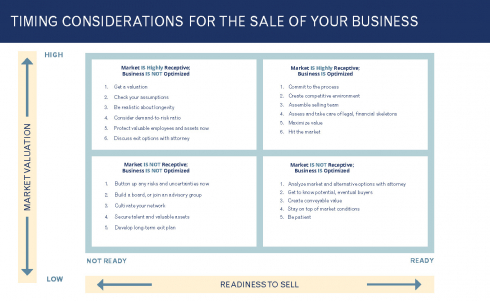
M&A Market Opportunity: Is Now The Right Time To Sell Your Business?
Is now the right time to sell your business? Just as every business is unique, so is every sale. Some companies are well-positioned now; others need a longer runway. Still, others may find that market conditions in several years will yield even greater benefits, provided owners are ready to bear the potential downturn ahead. To find out where your business sits and determine the timing of your exit strategy, take a look at this infographic. When you’re ready to take the next step, Offit Kurman’s M&A attorneys are ready to make the deal happen. For more information and infographics about the current M&A market, click here. Market IS Highly Receptive; Business IS NOT Optimized Get a valuation Check your assumptions Be realistic about longevity Consider demand-to-risk ratio Protect valuable employees and assets now Discuss exit options with attorney Market IS NOT Receptive; Business IS NOT Optimized Button up any risks and uncertainties now Build a board, or join an advisory group Cultivate your network Secure talent and valuable assets Develop long-term exit plan Market IS Highly Receptive; Business IS Optimized Commit to the process Create competitive environment Assemble selling team Assess and take care of legal, financial skeletons Maximize value Hit the market Market IS NOT Receptive; Business IS Optimized Analyze market and alternative options with attorney Get to know potential, eventual buyers Create conveyable value Stay on top of market conditions Be patient
June 27, 2024
Mergers and Acquisitions
Infographic: The Sell-Side M&A Attorney Team
Mergers and acquisitions (M&A) are a team sport. It takes multiple people to successfully close a business transaction: the business owner or owners, the buyer, each side’s accountants and advisors, and multiple attorneys working together. For the seller, their M&A process will involve a number of attorneys through the deal lifecycle, including the corporate attorneys driving the transaction and several subject matter attorneys weighing in on select deal aspects (like tax issue, for example). To help sellers navigate the process, we’ve put together an infographic showing the lifecycle of a sell-side transaction and the sell-side attorney team’s participation and timing throughout a transaction. Below, you’ll discover what attorneys you’ll need to bring on, and when, along with a few key tips and considerations for closing the deal. To talk to an experienced M&A legal advisor, be sure to contact Mike Mercurio at mmercurio@offitkurman.com or 301.575.0332.
June 13, 2024
Mergers and Acquisitions
About to Sell Your Business? Don’t Schedule Vacation Yet
Perhaps, you’re like a number of business sellers I’ve recently worked with and you’re planning to exit your company. If you’re a business owner and you’ve already received a letter of intent (LOI) from an interested buyer, a massive payday may appear to be right around the corner. I’m sure it seems like the perfect occasion to schedule that long-awaited trip to Costa Rica, right? Not so fast. It’s understandable why a seller would get excited about an LOI. It’s certainly a significant mergers and acquisitions (M&A) milestone. It’s often the first time the seller sees a price in writing. It’s a tangible, formal-looking document that signals yes, this deal is really happening. But an LOI doesn’t indicate the end of the deal and unfortunately, it’s far from the end. LOIs are rarely legally binding and as their name suggests, they simply express a buyer’s intentions and solidifies their interest. An LOI is unlikely to reflect the eventual purchase price, or even indicate that the deal will in fact close. Many sellers fail to recognize this. They see a dollar amount — typically the largest sum they’ve ever encountered — and immediately start spending money they don’t have. One of the first things eager sellers do is book a vacation 30 days out to celebrate…but deals hardly ever consummate in 30 days or less. When M&A transactions do close, the final sale usually comes after months of hard work and negotiations. The receipt of an LOI is the wrong time to plan a trip. What an LOI means is that now it’s the time to hunker down and get serious about selling your business as quickly as possible. Save your vacation for when you’ve closed the deal. Besides, then you’ll be richer and more relaxed for it anyway. Originally posted 8/16/19. Updated 6/6/24.
June 6, 2024
Mergers and Acquisitions
Is Your M&A Attorney an Advisor or a Consultant?
For many people, selling a business is their largest, lifetime financial transaction. And typically, it is a one-time event. And further, most people have little experience with this transaction type. Consequently, surrounding oneself with good advisors and advisory teams is paramount. An M&A sale is essentially one really large commercial transaction. Of course, the transaction is documented with contracts containing a host of legal provisions. However, the details of the agreement essentially spin around a sophisticated circumstance where 2 or more parties are negotiating a financial transaction. Hence, understanding market and what are reasonable terms within the “bell curve” of options is important to the seller. The seller’s attorney must routinely work in the M&A space to have the current knowledge base of what is considered market. M&A is not a place to dabble. M&A attorneys must provide their clients with recommendations and suggestions – not merely options, information, and forks in the road. Reviewing complicated purchase agreements and understanding the terms is most basic; providing true counsel and advice is a must. I have practiced in the M&A space for more than 25 years representing both buyers and sellers. My practice and my colleagues at Offit Kurman have successfully concluded hundreds of transactions by carefully subscribing to the formula of (i) educating our clients on the circumstances; (ii) making concrete and definitive recommendations; and (iii) understanding the client’s risk tolerance and ultimate objectives to assist the client with arriving at their decision. Because in the end the M&A transaction is likely the largest financial transaction for most clients. Originally posted on 12/4/2020, no content changes.
May 30, 2024
Mergers and Acquisitions
3 Questions and 3 Pieces of Advice: In a Hot M&A Market, Is Now the Time to Sell Your Business?
The M&A market has been very robust over the last few years. This year the market is still receptive to deals. With all of the momentum this M&A momentum, many business owners have a once-in-a-lifetime opportunity to retire wealthy. To take advantage of that opportunity, however, owners need to act fast. The market won’t stay receptive for much longer. And with a potential economic downturn ahead, the next window to maximize sales value may be five or 10 years out. As I have been telling my clients, now is the time to choose a path: a) get ready to sell your business as soon as possible, or b) prepare to keep running it through the next few years. To determine which path is right for you, consider the following questions: Do you feel emotionally ready to sell? The sale of a business is likely the most sophisticated and largest transaction a seller will encounter in the course of their career. There’s a reason most only go through with it once. Even with years of preparation, no owner can fully predict the myriad of issues and uncertainties in M&A until a buyer commences diligence. You need to be ready for ups and downs, back and forth negotiations, false starts and sudden surprises. Do you know what your business is really worth – and how much M&A may cost? Get a valuation – perhaps more than one. Owners are too close to their businesses to assess their worth objectively. Once you truly understand the value of your company, be prepared to set aside more than you think you’ll need to sell your business. Even if you achieve ideal terms, you will need to be ready to cover any trailing liabilities post-closing. How long will you have the energy to continue running your business? The older you get, the more critical the decision to sell your business becomes. Owners need to be realistic about their abilities and limitations, particularly if things were to go sour: e.g. contacts disappear, key employees leave or industry disruption makes the business irrelevant. Even if a potential deal doesn’t seem perfect, an owner selling now would have a longer runway to retirement. Otherwise, the owner would need to spend the next few years working harder than ever to carve out better numbers. Whichever path you choose – selling now or waiting – there are three steps you can take to set yourself up for M&A success: Commit to your plan. Do not let others set the terms of your business’s outcome for you. Use the market to your advantage. If you’re thinking of selling now, don’t sign the first letter of intent that comes your way. If you’re waiting it out, don’t concede to a mediocre offer in a couple years; instead, turn into an opportunity to create competition over your business. Focus on creating conveyable value. This one is simple: maximize your earnings, minimize your risks and secure your greatest assets – be they contracts, intellectual property, real estate or skilled employees. Build the team. Whether selling now or later, consider hiring an M&A advisor – they tend to pay for themselves. At the very least, discuss your exit plan with your financial planner, CPA and attorney. Look within your organization for people you can trust to go to bat for the business during negotiations with a buyer: executives, board members and finance personnel are good candidates. Make no mistake: M&A is a challenging and costly prospect no matter what the market looks like. But by developing the right strategy, setting the right expectations and finding the right allies early on, any business owner can begin their exit with confidence.
May 23, 2024
Mergers and Acquisitions
M&A: Matching Priorities – Buyer and Seller
In the context of M&A, frequently the priorities of a buyer and a seller differ, especially at the outset of a transaction. In sum, what may be important to a buyer, frequently is not on the radar of a seller. Why? Simply put, how a seller operates its business day to day most times is not focused on risk mitigation and value drivers. For example, frequently I find that seller’s have promised key people compensation in the event of the sale but just have never gotten around to documenting the details. Or simpler yet, numerous sellers cannot locate their stock certificates or recall the basics of their corporate governance. These details, while important, do not rise to top priorities for the entrepreneur focused on the next sale or cash flow issues. A buyer, however, is most focused on a return on their investment and related risk mitigation. Hence, the disconnect. So, what’s the solution? Proper planning. The simple fact is that how an entrepreneur operates his/her business will not be how he or she sells the business. As such, if the entrepreneur has the luxury of some time before the sale, then he/she should use the ramp up as a means to check on the readiness of the business for sale. Too many sellers become faced with the “triple threat” during the sale of their business: (i) selling their business; while (ii) adjusting their business to the expectations of the buyer; all while (iii) still operating their business. I can assure you this is no easy task.
May 16, 2024
Business
The Current M&A Market: Three Questions & Three Pieces of Advice
In an Uncertain M&A Market, Is Now the Time to Sell Your Business? 3 Questions and 3 Pieces of Advice In the lower middle market, the mergers and acquisitions market is still hot (despite the larger economic challenges). This is largely due to a combination of issues, including “Covid hang-over” concerns, challenges with hiring and retaining employees, baby-boomers getting older and the large amounts of cash that still needs to be deployed. As a result, many business owners have a once-in-a-lifetime opportunity to retire wealthy. To take advantage of that opportunity, however, owners need to act fast. The market won’t stay hot forever. And with a potential further economic downturn ahead, the next window to maximize sales value may be five or 10 years out. As I have been telling my clients, now is the time to choose a path: get ready to sell your business as soon as possible, or prepare to keep running it until the next M&A window develops. To determine which path is right for you, consider the following questions: Do you feel emotionally ready to sell? The sale of a business is likely the most sophisticated and largest transaction a seller will encounter in the course of their career. There’s a reason most only go through with it once. Even with years of preparation, no owner can fully predict the myriad of issues and uncertainties in M&A until a buyer commences diligence. You need to be ready for ups and downs, back and forth negotiations, false starts and sudden surprises. Do you know what your business is really worth – and how much M&A may cost? Get a valuation – perhaps more than one. Owners are too close to their businesses to assess their worth objectively. Once you truly understand the value of your company, be prepared to set aside more than you think you’ll need to sell your business. Even if you achieve ideal terms, you will need to be ready to cover any trailing liabilities post-closing. How long will you have the energy to continue running your business? The older you get, the more critical the decision to sell your business becomes. Owners need to be realistic about their abilities and limitations, particularly if things were to go sour: e.g., contacts disappear, key employees leave, or industry disruption makes the business irrelevant. Even if a potential deal doesn’t seem perfect, an owner selling now would have a longer runway to retirement. Otherwise, the owner would need to spend the next few years working harder than ever to carve out better numbers. Whichever path you choose – selling now or waiting – there are three steps you can take to set yourself up for M&A success: Commit to your plan. Do not let others set the terms of your business’s outcome for you. Use the market to your advantage. If you’re thinking of selling now, don’t sign the first letter of intent that comes your way. If you’re waiting it out, don’t concede to a mediocre offer in a couple years; instead, turn into an opportunity to create competition over your business. Focus on creating conveyable value. This one is simple: maximize your earnings, minimize your risks and secure your greatest assets – be they contracts, intellectual property, real estate or skilled employees. Build the team. Whether selling now or later, consider hiring an M&A advisor – they tend to pay for themselves. At the very least, discuss your exit plan with your financial planner, CPA and attorney. Look within your organization for people you can trust to go to bat for the business during negotiations with a buyer: executives, board members and finance personnel are good candidates. Make no mistake: M&A is a challenging and costly prospect no matter what the market looks like. But by developing the right strategy, setting the right expectations, and finding the right allies early on, any business owner can begin their exit with confidence. © 2017 - 2023 Michael N. Mercurio. All Rights Reserved. Originally posted 9/23/2020, content updated 11/2/2023.
November 2, 2023
Business
The Entrepreneur’s Lab Video Series: Due Diligence
Due Diligence, exchanging information and documents during a sales transaction can be a tricky proposition. During our business life, we do all we can do to keep our information and data private. With the transaction, a seller will be asked to tell and show all. Due Diligence is typically conducted in three buckets: financial, legal and operational. As a seller moves beyond the letter of intent, the diligence process intensifies. There will be a natural tension between buyer and seller as to what to disclose and when. Sellers naturally want to keep their data, customers, employees, and other items close to the vest. Buyers want to know about contracts, customers, and employees ASAP. So, what should a seller do? Here are a few tips. Make certain to have a strong confidentiality agreement that contains non-solicitation provisions from the buyer. Understand that disclosure is the friend of the seller. Few businesses have zero nicks. Disclose the good, the bad, and the ugly to any buyers. Note that diligence is a process that continues to closing; manage the process with the buyer so that risk is mitigated. For example, hold back introductions of clients and employees to the buyer until such time that the deal is on firm ground. Last, and most importantly, get organized. Nothing is worse than a shoebox full of papers. Being disorganized during diligence will cost the seller valuable time and money. Originally posted 1/26/2018, no content changes.
October 24, 2023
Business
Healthy Businesses Lead to Successful Sales: Business Ownership Maintenance is Key
What does getting your car its annual safety inspection and selling a business have in common? More than seems obvious. Many states require annual safety inspections for vehicles. Maryland is one of the states that does NOT have this annual safety inspection. In Maryland, your vehicle does not need to be safety inspected until you seek to transfer the title. Thus, in practice, there are many cars in Maryland on the road for years that have not been safety inspected. Hence, numerous vehicles are driving around that may have “issues” that the owners are not aware of. My personal experience has shown that when you transfer a vehicle in Maryland and have the car inspected, you are suddenly faced with numerous vehicle “defects” that must be fixed to pass inspection and transfer title. Fast forward to selling a business. In my experience, I have not come across a single business that was without “defects” in the sale process. Like the running car, these businesses are operating and making money. However, when the business goes to sell, the buyer and its advisors will conduct a thorough inspection. Too often, many defects rise to the surface, requiring remedy before the sale can proceed. In this series of articles, I will be discussing the best ways to start, grow, and maintain a healthy business by reflecting on top issues when selling a business and what can be done to set up a business for a successful sale. This series will include annual “inspections” by the owner in the areas of legal, operation and financial to better prepare the business for sale. Frequently defect areas often include tax planning, employment and key employees, intellectual property, ownership issues/operating agreements, cap tables, and corporate governance issues.
September 21, 2023
Business
Why is M&A Due Diligence Important?
The success of a Merger and Acquisition (M&A) deal depends heavily on the due diligence process. Due diligence refers to the investigation and analysis of a company's financial and legal information to identify potential risks and opportunities associated with an M&A transaction. M&A due diligence is critical for several reasons. First, it helps the acquiring company to identify potential risks associated with the acquisition, such as legal or financial liabilities, compliance issues, or hidden costs. This information is vital in negotiating the terms of the deal and determining the fair value of the target company. Second, due diligence can help identify potential synergies and opportunities for growth that the acquisition may bring. By analyzing the target company's financial and operational data, the acquirer can identify areas where cost savings can be made, revenue can be increased, or efficiencies can be gained. Lastly, due diligence can help the acquirer to develop an integration plan and manage the transition process more effectively. By understanding the target company's operations and culture, the acquirer can plan and execute a seamless integration that minimizes disruption and maximizes value. Key Steps in M&A Due Diligence The due diligence process can be complex and time-consuming, involving a range of activities, such as financial analysis, legal review, and operational assessments. Below are some of the key steps involved in M&A due diligence: Identify Key Areas for Investigation: The first step in the due diligence process is to identify the key areas of investigation. This may include financial statements, tax records, legal documents, customer contracts, employee agreements, and operational data. Conduct Financial Analysis: The financial analysis involves a detailed review of the target company's financial statements, including income statements, balance sheets, and cash flow statements. This analysis helps identify potential financial risks and opportunities associated with the acquisition. Review Legal Documents: The legal review involves a thorough analysis of the target company's legal documents, such as contracts, agreements, leases, and intellectual property rights. This review helps identify any legal risks or liabilities associated with the acquisition. Assess Operational Data: The operational assessment involves a review of the target company's operations, including production processes, supply chain management, and customer service. This assessment helps identify potential synergies and opportunities for operational improvement. Identify Risks and Opportunities: Based on the findings of the due diligence process, the acquirer can identify potential risks and opportunities associated with the acquisition. This information is used to negotiate the terms of the deal and develop an integration plan. Develop an Integration Plan: The integration plan outlines the steps required to integrate the target company into the acquirer's operations successfully. This plan should address key areas such as organizational structure, culture, systems integration, and communication.
May 4, 2023
Business
How to Avoid Derailing Your Sell Side M&A Transaction
There are many items and considerations that can derail your sell side M&A transaction. Active litigation, titling issues to assets and employee/benefit matters all could lead to the quick demise of your sale. Most times, these items are found when due diligence commences in earnest by your buyer. However, the single most item that will tank your deal (or have buyers pass before a deal commences) relates to sloppy financial books and records. A seller’s financial data is generally the first substantive intersection with a buyer. Even before a letter of intent is submitted, a buyer will want to see some financial records of the potential target. If the seller’s records are disorganized and not in accordance with proper standards, most buyers will move on. For all business owners having good financial statements is vital to operating a successful business; for sellers in the market, hoping clean records is a must-have. The inability to show the buyer financial value and clean operations is the foremost deal killer for a seller. Sellers wanting to sell their business should have their books and records scrubbed before going into the marketplace to make certain their finances are clean, normal and what would be expected by a buyer. Failure to do so may prevent a seller from landing that large payday.
May 13, 2022
Business
Tax Considerations when Selling your Business
Most business owners pay their fair share of taxes while running their company. When it comes time to sell the business, most owners are seeking tax strategies to minimize taxes paid on their gain. We know that tax considerations are a major driver of any commercial transaction, especially M&A transactions. So, what should a seller keep in mind when considering a sale? First, before going into the market and soliciting letters of intent (LOI), sellers should update their estate plan and engage in pre-transaction tax planning. Ideally, this planning should be finalized a year in advance of a sale. The closer to the sale, the less tax planning opportunities available. Estate planning strategies including gifting and otherwise transferring interests to reduce wealth received directly by the seller. Pre-tax planning may include reorganizing the structure of the business or changing tax elections. Once the seller receives an LOI, the proposed structure of the transaction becomes paramount for the seller’s tax planning. For example, structuring the transaction as an equity purchase likely could result in long-term capital gains treatment for the seller. An asset sale structure could lead to a mixed result of ordinary income as well as capital gains for the seller, depending on how the purchase price is allocated. Most times, a change in structure that benefits one party is a negative for the other party. Thus, the seller must have competent legal counsel versed in M&A and taxation issues. Further, how a purchase price is paid to the seller may have implications on timing as well as the treatment of the income. Monies paid overtime may lead to tax on the income being deferred to later years. Monies paid in forms such as for employment or consulting services or in consideration of a restrictive covenant likewise could have particular tax implications. In summary, selling a business is most times the largest financial transaction for an entrepreneur. Making certain to understand the tax treatment and implications at the earliest is paramount. After all, for any entrepreneur, the bottom-line net amount is what ultimately counts, not the top-line valuation.
April 20, 2022
Business
Before You Sell – Have an Accurate, Realistic Understanding of What You Actually Own
This statement seems obvious, right? From experience, I can tell you that while obvious, some sellers find out during the diligence and sale process that they do not own what they thought they owned. Take intellectual property and software rights as an example. Ownership of the software and the underlying source code can be complicated especially if the software went through a number of iterations. It can be fatal to a transaction to find out a key piece of software is not owned by the seller, or the seller has not secured the proper underlying licenses granting it the authority to do what it is doing. A best practice for all business owners is to regularly inventory their assets and confirm the ownership sourcing. Hard assets are easy to source, but finding titles and releasing liens during a transaction can add unnecessary stress. Soft assets can be tricky. A businesses’ name, logo and tag lines can be issues if the business never took the proper steps to register and confirm there were no conflicts. There is nothing worse than determining a business’ name has a conflict with another business and having to then rebrand the business and take a new course. In sum, the time to determine asset ownership and the status of any clean-up is well before being asked by a buyer to provide confirmation of ownership during the sale process.
February 9, 2022
Business
How to Know if You’re Ready to Sell Your Business
As a business owner, how does one now know the time is right to sell? The easy answer is that the time is right when the owner decides to sell. However, that answer is too simplistic and does not serve the owner well. There are two primary factors to evaluate the timing to sell a business – external considerations and internal considerations. External considerations frequently are not well vetted by many owners. External factors include the market conditions, such as the general receptivity to the owner’s business type (e.g., is the market hungry to acquire PT practices). Other external factors that impact market conditions include the tax framework and access to capital. As mentioned, too many owners decide they want to sell without fully understanding the external considerations as to the optimal time to sell their business. The reason this happens relates back to the internal considerations. The owner determines they want (or need) to sell. It could be circumstantially driven (a family illness or death). It could be a mindset such as an owner being fed up with the pandemic. Regardless, the internal pressures/decisions often outweigh what is going happening in the rest of the world. An owner can manage their mindset by getting themselves fully informed about the true state of their business and how it presently fits into the marketplace. In addition to speaking with the company attorney and CPA, the owner can get the insight of 2 other advisors and services. First, the owner may want to speak with an investment banker. The investment banker can provide the owner with market intelligence about the receptibility of the market to the owner’s business, as well as give the owner insight into how to position the business best for the sale. Further, the owner should speak with a financial advisor. Because a significant component of any sale relates to financial considerations, having an excellent financial advisor help the owner understand their financial picture is key. The financial advisor should do two things. First, this advisor should work with the investment banker/CPA to get a true market value for the business to include the likely composition of sale funds (all cash, cash plus deferred monies, etc.). Second, the financial advisor should work with the owner on their personal financial situation. Having an understanding of what the business is likely worth in the market coupled with the financial needs of the owner allows the owner to go into the selling state fully informed and ready to powerfully evaluate any offers. I find that too many owners decide to sell without having their financial house in order and thus have no ability to vet offers to know that the offers are fair and workable. Lastly, an owner may know they are ready to sell when their mindset is clear. When they have purpose beyond the business. I have experienced a number of owners that have sold their business only to become lost and disaffected. An owner that wants to sell needs to deliberately develop their “life” after their business is sold.
January 20, 2022
Business
Five Phases of a Deal from a Sell-Side Perspective: Due Diligence
You’ve signed your letter of intent (LOI). So what’s next? Now it’s time to roll up your sleeves as the real work on your sale begins. Due diligence commences. Prior to signing the LOI, you likely provided your buyer some limited financial diligence, enough that the buyer could determine to move forward and on what proposed terms. With the LOI execution, the buyer will now seek to learn much more about your business. Diligence will generally fall into three categories –financial, legal and operational. As a seller, the buyer will send you a very long and detailed diligence request list. Many times, this request list feels very overwhelming and beyond the scope of your business. This is intentional by the buyer. The buyer is casting a very large net in an effort to uncover and learn about your business in every aspect. Your approach to due diligence likely will require a new mindset. Diligence is opposite the natural inclination of entrepreneurs. Diligence requires disclosure of all things in your business –the good items and the not-so-good items. However, in all events, disclosure and diligence is the seller’s friend. Fully opening up your business in a complete and honest fashion allows the buyer to fully understand the mechanics of your business. The seller should not withhold or color any responses in an attempt to mitigate or spin matters. Rather, disclose what is requested and allow the buyer to ask its questions and make it own conclusions. No seller wants to be in a position where a buyer would revise its intentions had it known about an item (think fraud in the worst case). At times, a buyer will modify terms of the transaction (price, payment, etc.) based upon the diligence findings. While this is not usually positive for the seller (terms usually don’t get better), it is the opportunity for the parties to have open dialogue based on the same business knowledge. And remember, as a seller, diligence is a continuing process up until closing. It is not good enough to disclose and forget. Business is ever moving, and as items change in your business, the seller has the duty to update diligence to the buyer. Anatomy of the Deal 5 Phases of a Deal from a SELL-SIDE PERSPECTIVE: The Players and Their Involvement Pre- Transaction Planning Phase Rule: Find and eliminate skeletons; create multiple options Phase I: Letter of Intent Phase Rule: Know what you want and get it in writing as the LOI may be your high water mark Phase II: Due Diligence Phase Rule: Disclosure is your friend Phase III: Contracts Phase Rule: Confirm Business terms and Phase IV: Closing Phase Rule: Time is your enemy Phase V: Post Closing Phase Rule: Remember to dot the I’s and cross the t’s to meet all conditions Post-Transaction Planning Phase Rule: Enjoy your new status in life; make sure you’ve considered life without the business Sell Side M&A: Three Rules of Thumb for the Transaction Rule #1: You haven’t sold your business until you’ve sold your business Rule #2: Get your money upfront (as soon and as much as possible) Rule #3: Reduce and eliminate your trailing liabilities
December 22, 2021
Business
Trends in the M&A Market Heading into 2022
M&A in 2021 is roaring to a close. Most will agree that the 2021 M&A market was exceptional, regardless of geography, industry, sector, etc. Many deals were successfully closed, and a number of transactions are still pushing towards the finish line. What has driven this robust market? I think 3 factors have played a large role. First, the continuing Covid cloud has pushed many sellers into the marketplace that considered sale transactions sooner than they may have otherwise. Covid impacted everyone and for many business owners, the uncertainty around Covid made some owners conclude they want out – or at least to take some risk off the table. Second, though rates, etc., are slowly creeping up, access to money and significant funds on balance sheets have translated to many buyers in the market. The match of multiple buyers with many sellers has driven values up. Deals are bigger than they might have been. Third, tax considerations and the potential for taxes to increase has caused significant pressure to get the deal concluded in 2021. So what does 2022 look like? In my opinion, 2022 will continue where 2021 left off. Covid issues are still with us and the uncertainties of Covid shutdowns and restrictions matched with vaccine mandates are proving too much for some business owners. This will continue to cause many sellers to look for a deal. Further, there are still funds to be had and money to be invested. The M&A boom in this regard has not flattened and I do not believe it will go into 2022. And taxes? Who knows. Earlier in 2021, it appeared certain there would be tax changes that would make business taxes higher. But now there is much speculation, given recent political events, that any tax law changes may not be as significant or perhaps there will not be any tax changes next year given it is an election year with much at stake. So, in conclusion, if you are considering a business sale but did not get moving in 2021, I think 2022 will continue to be a receptive marketplace for buyers and sellers to make good deals!
December 8, 2021